
 AGVHub
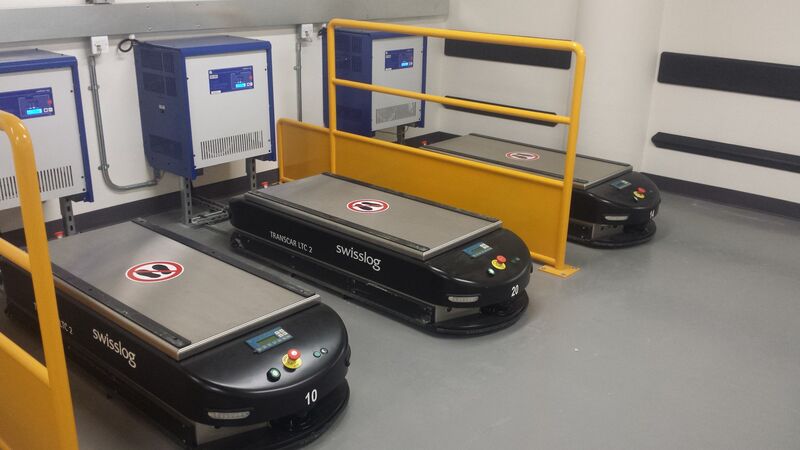
Battery and Energy Systems for AGVs
Lead-acid vs. lithium-ion, charging strategies, and battery management: Everything about AGV energy systems and their impact on operations and total cost.
The Power Behind the Vehicle
The battery is one of the most underestimated components in an AGV system. It determines how long vehicles can operate between charges, how many vehicles you need, where charging stations go, and what your operating costs look like over the system's lifetime.
Choosing the wrong battery technology or charging strategy can force expensive retrofits later. Getting it right from the start saves money and avoids operational headaches.
Start With Your Shift Model
The most practical way to approach AGV energy is to start with your operations, not with battery specs. Your shift model determines how vehicles need to charge, and that drives everything else.
Single Shift
Vehicles work during the day and charge overnight. The simplest setup: fewer charging stations, lower infrastructure cost, and almost any battery chemistry works. The trade-off is that vehicles sit idle for long stretches.
Two Shifts
Vehicles charge during breaks and shift changes. This requires lithium-ion batteries that tolerate frequent partial charging. Infrastructure needs grow moderately, but vehicle utilization increases significantly.
Continuous (24/7)
Vehicles grab short charges whenever they have a natural pause, for example while waiting at a load station. This requires more charging points distributed across the facility, but fewer vehicles overall since availability stays high.
Battery Swap
Empty batteries are swapped for charged ones at a dedicated station. Common with lead-acid systems in multi-shift operations that cannot yet invest in lithium. Requires space for the swap station and spare battery inventory.
Choosing the Right Battery Chemistry
Once you know your shift model, the battery chemistry follows. The market has largely settled on four options.
Li-Ion LFP: The Industry Standard
Lithium Iron Phosphate has become the default for new AGV projects. It handles continuous partial charging without significant degradation, offers a long service life, and has an excellent safety profile (no thermal runaway under normal conditions). The upfront cost is higher than lead-acid, but the total cost over the system lifetime is typically lower.
Lead-Acid: Still Around for a Reason
The cheapest option upfront and well understood after decades of use. Lead-acid batteries are heavy, which can be an advantage in counterbalance forklifts where weight improves stability. The main limitation is the long full-charge cycle, which makes them impractical for anything beyond single-shift operations without battery swapping.
Li-Ion LTO: When Speed Matters Most
Lithium Titanate cells accept extremely high charge currents, enabling full charges in very short windows. They also have the longest service life of any lithium chemistry. The downside is lower energy density and higher cost per kWh, which limits them to specific use cases where ultra-fast turnaround is essential.
Li-Ion NMC: Lightweight, But Trade-Offs
Nickel-Manganese-Cobalt cells pack the most energy per kilogram, making them attractive where vehicle weight matters. The trade-off is a shorter service life compared to LFP, which means higher replacement costs over time. More common in electric cars and consumer electronics than in industrial AGVs.
| Chemistry | Energy Density | Service Life | Charge Speed | Safety | Best For |
|---|---|---|---|---|---|
| LFP | Medium | Long | Moderate | Excellent | Most AGV applications |
| Lead-Acid | Low | Short-Medium | Slow | Good | Budget, single-shift |
| LTO | Low-Medium | Very Long | Very Fast | Excellent | Ultra-fast turnaround |
| NMC | High | Medium | Moderate | Moderate | Weight-sensitive |
Keeping Batteries Healthy
A Battery Management System (BMS) monitors and protects the battery pack. At a minimum, every lithium battery needs hardware protection against overcharge, deep discharge, and overtemperature. Better systems add individual cell balancing, which ensures all cells in a pack age evenly. The most advanced systems track battery health over time, predict remaining capacity, and communicate with the fleet manager to optimize charging schedules. This level of intelligence pays for itself through longer battery life and fewer surprises.
Alternative Energy Approaches
For most projects, conventional batteries with contact-based charging are the right choice. But some scenarios benefit from alternative approaches:
- Inductive (contactless) charging transfers energy wirelessly via magnetic fields. No physical contact means no wear and no sparks. Works well at fixed stations where vehicles pause regularly.
- Supercapacitors charge in seconds and last virtually forever, but store far less energy than batteries. Useful as buffers in hybrid setups to handle power peaks during acceleration or lifting.
- Hybrid systems combine a small battery with contactless energy transfer along defined routes (e.g. assembly lines). The battery bridges sections without power supply.
- Fuel cells (hydrogen) offer fast refueling and long range, but the infrastructure requirements make them a niche solution today.
Impact on TCO and Layout
Battery decisions ripple through your entire project. Here is what to watch for:
Cost Factors
- Upfront: Lead-acid is cheapest, LTO is most expensive per kWh
- Replacement: Lead-acid packs need replacing much sooner than LFP packs
- Infrastructure: Continuous charging needs more stations but fewer vehicles
- Energy: Li-Ion systems are more energy-efficient (less heat loss)
Layout Factors
- Charging zones: Overnight charging needs fewer, larger stations; continuous needs many small ones
- Floor space: Battery swap stations require additional staging area
- Ventilation: Lead-acid charging produces hydrogen gas, requiring ventilation
- Electrical supply: Fast-charging stations may require upgraded power distribution
Conclusion
The energy system is not just a technical detail, it is a strategic decision that affects vehicle count, layout, uptime, and total cost. Start with your shift model to determine how vehicles need to charge, then pick the chemistry that matches. LFP lithium-ion with continuous charging has become the standard for new installations, but the right choice always depends on your specific operation. Evaluate the full lifecycle cost, not just the purchase price.